AUTHOR GUIDELINES
- Author Guidelines Jurnal Pendidikan Manajemen Perkantoran (JPManper)
- Author Guidelines can be Downloaded here
- Journal Template (DOC) Jurnal Pendidikan Manajemen Perkantoran (JPManper)
- Author Submission Guidelines Jurnal Pendidikan Manajemen Perkantoran (JPManper)
- General guides for Author:
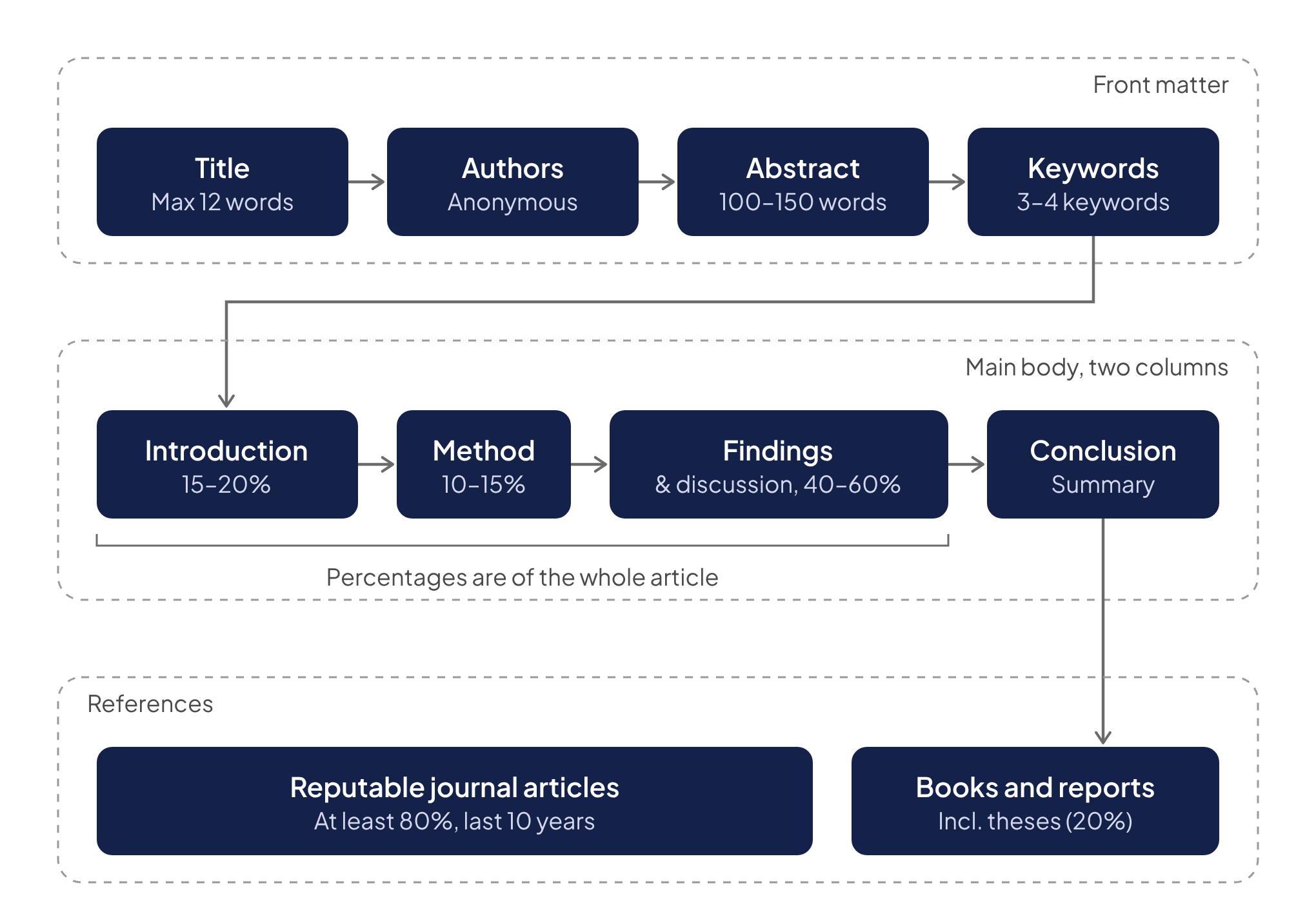
- The manuscript should contain between 5,000 and 7,000 words, or 14–17 pages.
- Submitted articles undergo a blind review process. To facilitate this, the authors’ names (without academic titles), institutional affiliations, and email addresses are excluded from the review process.
- The submitting author must include a brief CV describing their current position and activities, no longer than 80 words.
- Articles must be written in Indonesian or English, single-spaced, using Microsoft Word, in Times New Roman size 12, with top and left margins of 3 cm and bottom and right margins of 2.54 cm, on A4 paper.
- The title must be no more than 12 words, written in capital letters, centered, in font size 14.
- The author’s full name (without any titles or honorifics) must be written together with the institution and complete address. The corresponding author must also provide an email address.
- The abstract must be 100–150 words and cover the key aspects of the research: background, objectives, methods, findings, and conclusions.
- Every manuscript must be accompanied by 3 or 4 keywords.
- The main body of the manuscript is written in two columns, except for figures and tables.
- Every figure and table must have a clear caption and be numbered sequentially in order of appearance. Footnotes to table content must be placed directly below the table. If a figure, table, or photo is taken from another publisher, the author must cite the source. Every figure and photo must be submitted as a separate electronic file.
- The introduction must explain the research background, research context, and research objectives.
- The introduction must consistently explain the research background, the research conducted (in context), the literature reviewed, and the research object. The entire introduction must be presented in paragraphs, not bullet points, and should make up 15–20% of the whole article.
- The method section describes in detail the research design, data sources, data collection, and data analysis. It should make up 10–15% of the article’s length and be presented in paragraphs.
- The findings and discussion section consistently describes the results of the data analysis to answer all research questions, explains the significance of the theory used, and addresses relevant references. This section should make up 40–60% of the total article.
- The conclusion section explains the summary, any changes in the initial statements, and comments or evaluations of the research findings.
- Use only horizontal lines when creating tables. Place the table number and title above the table.
- Every source cited in the article must appear in the references, and every source listed in the references must be linked to the body of the article (use Mendeley or Zotero with APA style to help with this process).
- Cited sources must be primary sources, with at least 80% from recent articles (at most the last 10 years) published in reputable national and international journals. The other 20% of primary sources may come from books and research reports, including theses and dissertations.
- Citations use parentheses (last name and year of publication). When a source is quoted word for word, the page number is included (p. 78 or pp. 78–89).
- Proof of article acceptance will be sent to the author for correction and must be returned to [email protected] by the given deadline.
- The references must be placed at the end of the manuscript.